Sale
Kuyper, Abraham
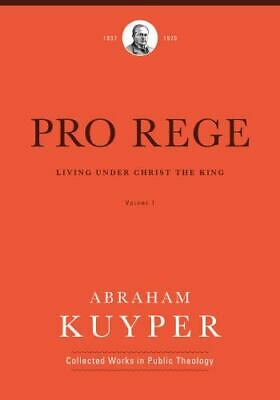
Pro Rege: Living under Christ's Kingship, Volume 3 (Kuyper)
$18.00
$49.99



Description
How do Christians bridge the divide between our lives inside and outside the church?
Abraham Kuyper believed that a healthy view of Jesus' kingship was essential to closing that gap. In Pro Rege, Kuyper shows how the kingship of Christ affects all areas of life, building upon the work he began in Common Grace. In this first volume, Kuyper examines how the kingdom of Satan opposes, undermines, and obscures the kingship of Christ. He follows this by laying out the Scriptural foundation for the kingship of Christ and beginning to uncover its implications for all of creation.
Contents
About the Editors
Jordan J. Ballor (ThD, University of Zurich; PhD, Calvin Theological Seminary) is a research fellow at the Acton Institute and serves as executive editor of the Journal of Markets and Morality. He is also associate director of the Junius Institute for Digital Reformation Research at Calvin Theological Seminary.
Melvin Flikkema (PhD, Fuller Theological Seminary) is Senior Advisor at the Acton Institute. He coordinated the translation of the Abraham Kuyper Collected Works in Public Theology. He was previously the Provost of Kuyper College.
About the Author
Abraham Kuyper (1837–1920) was one of the most extraordinary individuals of his time. A prolific intellectual and theologian, he founded the Free University in Amsterdam and was instrumental in the development of Neo-Calvinism. He was also an active politician, serving as a member of Parliament in the Netherlands beginning in 1874 and serving as Prime Minister from 1901 to 1905.
At this intersection of church and state, he devoted much of his writing towards developing a public theology. His passion was to faithfully understand and engage culture through a Christian worldview. The most famous example is his articulation of the doctrine of common grace. His work has influenced countless others, including Francis Schaeffer, Cornelius Van Til, and Alvin Plantinga.
Kuyper, Abraham

Kuyper, Abraham

Kuyper, Abraham
Kuyper, Abraham
Kuyper, Abraham

My Personal Guarantee to You
For over 30 years, I have personally reviewed and approved every book we sell at Reformation Heritage Books. My aim has always been to place into your hands books that are biblically and theologically sound, warmly Reformed, deeply experiential, and eminently practical—books that truly nourish the soul and your daily life as a Christian.
Here’s my personal guarantee: if you purchase a book from us and do not find it profitable, we gladly offer a full refund—shipping included. Feed your soul and mind with a good book today.
With warmest regards in Christ,
Dr. Joel R. Beeke
Founder and Chairman, Reformation Heritage Books